
Romans 14
Mound Books
€17,95 RRP €19,95
Sorry, this product is out of stock.
Description
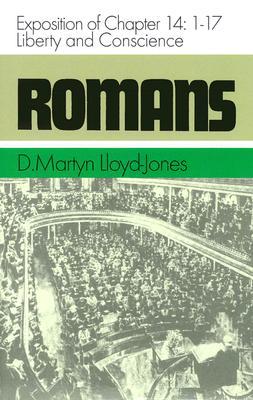
All Christians have been made free by Christ (John 8:36), but not all have an equally strong grasp of what this means in practice. Some are weakened by scruples about things which are strictly neither right nor wrong, while others assert their liberty in a way which risks doing violence to the consciences of the weak. It was this situation which the Apostle Paul addressed in Romans 14. He insisted that, while Christian liberty was to be maintained, it was never to be asserted in such a way as to hurt the consciences of others, or to embolden them to do what they believed to be wrong. \n \nIn this the last volume of the series, Dr Lloyd-Jones explains the implications of this issue for the church today. The fitting conclusion of his exposition of Romans is that true Christianity is not, in the end, concerned with such matters as what may be eaten or what days should be observed, but with a divine kingdom, characterized by inward righteousness, peace and joy. \n
TABLE OF CONTENTS
\n| \n | Preface | \nxi | \n
| \n | One | \n1 | \n
| \n | Relationships among Christians: problems over ‘matters of indifference’ – general analysis of 14:1 – 15:4 – weak and strong Christians – reasons for the difference: ability, temperament, diligence, time, and teaching – various manifestations. | \n\n |
| \n | Two | \n19 | \n
| \n | Our duty to welcome the weak –adding knowledge to faith – rules for discussion, argument and dialogue – the art of teaching one another in love. | \n\n |
| \n | Three | \n36 | \n
| \n | Jumping to conclusions – the issue of foods – kinds of vegetarianism – meat and the ceremonial law – despising and judging – the spirit of fear leading to legalism – asceticism and the temperance movement. | \n\n |
| \n | Four | \n51 | \n
| \n | Illustrations of legalism –divisions and discipline – Paul’ s apparent self-contradictions – not giving offence – evidence of being received by God. | \n\n |
| \n | Five | \n66 | \n
| \n | Christians as servants of God – standing firm in liberty by God’s power – apprehension contrasted with final perseverance – testimony from Scripture and great hymns. | \n\n |
| \n | Six | \n80 | \n
| \n | The Sabbath and the Lord’s Day – observing other special days – no extremes or bigotry – being fully persuaded in one’s own mind – educating conscience. | \n\n |
| \n | Seven | \n94 | \n
| \n | Motivation in serving the Lord – glorifying and thanking God – not desiring death: William Tennent and George Whitefield – always ready to die: Richard Baxter, Peter, John and Stephen. | \n\n |
| \n | Eight | \n111 | \n
| \n | Christ’s Lordship through His death and resurrection –His conquest of death and the grave – the devil and the fear of death defeated – Christians possess all things, even death. | \n\n |
| \n | Nine | \n129 | \n
| \n | Brothers, not judges – the judgment seat of Christ, who is God – all men will give account to God –judgment of believers: reward or loss, not final destiny. | \n\n |
| \n | Ten | \n145 | \n
| \n | Paul’s indirect approach completed – stumbling blocks and snares: never being a hindrance to one’s brother – Paul’s apostolic authority – nothing is unclean of itself –Peter and Cornelius. | \n\n |
| \n | Eleven | \n160 | \n
| \n | Those with different convictions to be considered – two causes of being grieved – strong in doctrine, weak in love – the meaning of ‘destroying’ one’s brother: the shipwreck of faith – following the example of Christ’s sacrifice. | \n\n |
| \n | Twelve | \n172 | \n
| \n | Actions good in themselves not always expedient –the importance of conscience –the good, weak, pure, defiled or seared conscience – its function as a safeguard. | \n\n |
| \n | Thirteen | \n186 | \n
| \n | The final perseverance of the saints – Hebrews 6:4–6 – dealing with apparent contradictions – controlling assertions about God’s purpose – the use of warnings to preserve – the weak must be teachable – the limits of accommodation. | \n\n |
| \n | Fourteen | \n202 | \n
| \n | A magnificent summary statement – a matter of balance and proportion – the importance of church unity – denominations and movements – examinations and theological colleges –a closing prayer . | \n\n |
| \n | Fifteen | \n217 | \n
| \n | Rules for thinking about the kingdom of God – always consider the parts in relation to the whole –the whole man must be involved – start with the reign of God in Christ – remembering one’s exalted place in the future kingdom. | \n\n |
| \n | Sixteen | \n230 | \n
| \n | Christians must think differently, as befits citizens of the kingdom – the church not a democracy – seek first the kingdom of God –the kingdom is larger than any individual aspect –how this greatness is to be shown to the world. | \n\n |
| \n | Seventeen | \n244 | \n
| \n | Righteousness: imputed or ethical? –right personal relationships – more than an ethical statement – belonging to the realm of righteousness –Christians are like Jesus Christ the righteous. | \n\n |
| \n | Eighteen | \n257 | \n
| \n | A morbid scrupulosity ruins peace –it leads to a censorious spirit – it harms our relationship with God – peace from the God of peace – reconciliation with God leads to peace within, and with each other –rejoicing in the Prince of Peace. | \n\n |
| \n | Appendix: The Romans Series | \n


